
Life Schooling Guide: Steps to Planning a Relaxed Homeschool
This Life Schooling Guide will help you take steps to plan a more relaxed homeschool. Life Schooling (or “Lifeschooling” when you’re not concerned about the search engines finding you 😉 ), sometimes referred to as Christian Unschooling, is a relaxed form of homeschooling that focuses on each child’s individual gifts and the educational value of everyday life. It is the direct opposite of the school-at-home approach, which focuses on some “magical” body of knowledge that every child must know in order to be “educated.”
You know, the old Scope and Sequence, or “What your _-grader needs to know” mentality. Having a general idea of what other kids are learning isn’t altogether bad. But who gets to determine these standards, and can’t a child learn multiplication in fifth grade instead of third? These are questions many parents don’t think to ask, but it’s worth considering.
While I’ve written an entire book on the topic of Life schooling, focusing on the Four Es and some practical ways of going about the process of Life Schooling, I decided it was time to finally write a blog post that could give direction to those of you fellow short-attention-spanned homeschool moms who just want the cliff notes version!
I’m here for you. (Even though I still think you’d benefit from reading the book…but this Life Schooling guide will get you started.)
QUICK NOTE: We interrupt this amazing blog post to let you know that you have an opportunity to win a $200 gift card to the curriculum vendor of your choice, just in time for the new homeschool year! You can find all the details at the end of this post. Okay, carry on…

A Life Schooling Planning Illustration
First, let me paint a mental picture for you. There are two moms, Jenny and Sarah, who are planning their Life Schooling.
Here is how Jenny approaches her planning:
- Thinks about what she wants to teach.
- Prays about it.
- Goes to a conference vendor hall, get sucked in by amazing-looking curricula and sales pitches.
- Adjusts her goals (and budget) so she can buy things she doesn’t need.
- Spends $400 on “necessary” curricula.
- Uses it for three weeks, realizes she’s made a big mistake, and then ditches it.
Now, here’s how Sarah plans her year:
- Thinks about what she wants to teach.
- Prays about it.
- Goes to a conference vendor hall. Does not get sucked in by any of the amazing-looking curricula or sales pitches.
- Does not adjust her goals and buys only what she thinks she needs.
- Sticks religiously to her budget and only buys necessary curricula.
- Uses it for three weeks, realizes she’s made a big mistake, but sticks with it out of principle, trying different schedules and approaches to make it work.
Anyone relate? Well, I relate to Jenny. In fact, Jenny’s experience perfectly describes one particular year for me and may or may not have been inspired by said year.
And that was the year I finally decided I needed to figure out a better way.
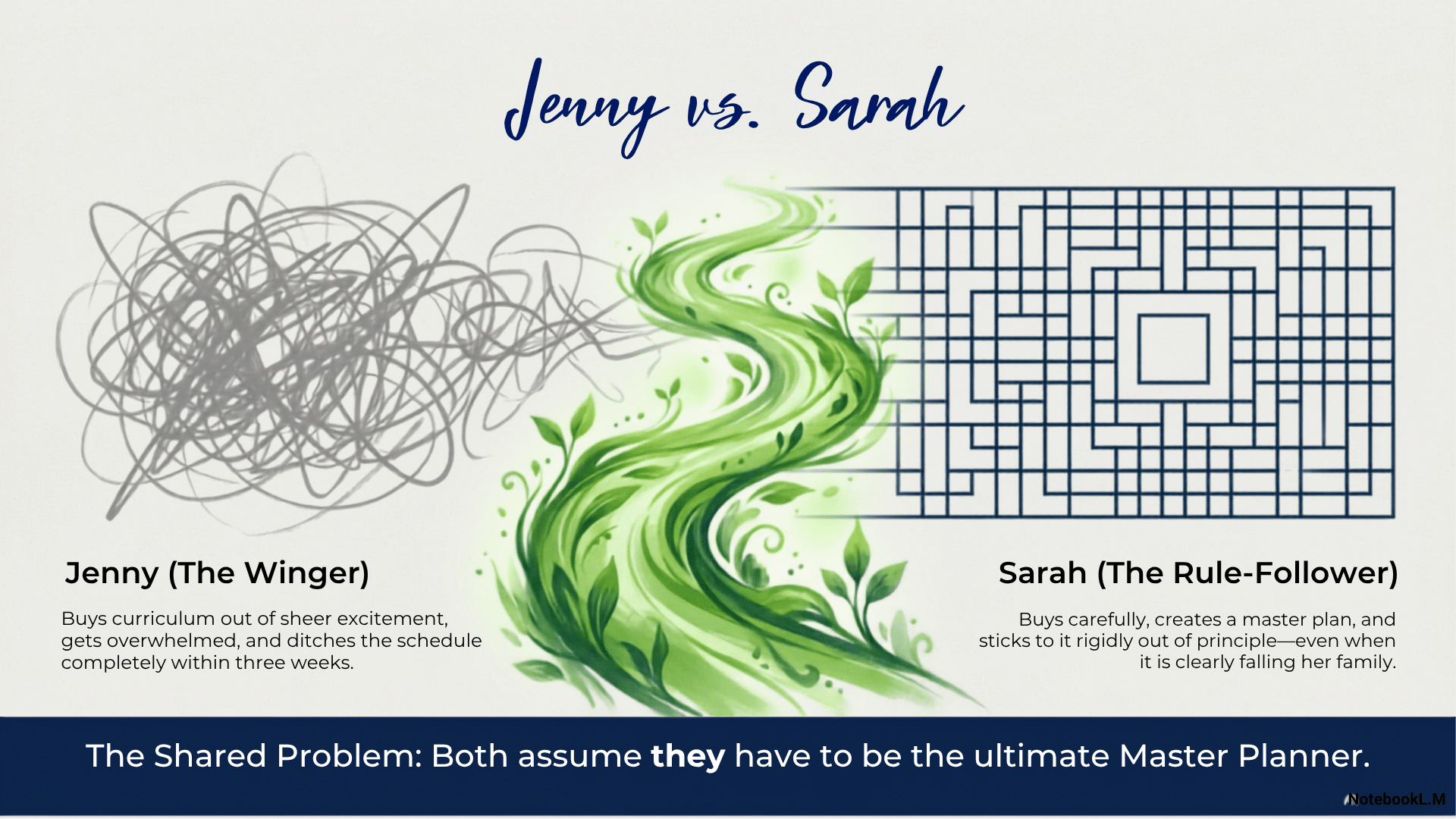
Of course, these are just examples and they have limitations. Maybe you are a little of both Jenny and Sarah, or Jenny one year and Sarah the next, but I think we can all relate to the tendency to either throw out the schedule altogether or stick with it like the 10 Commandments.
Most of us tend toward being unscheduled or ultra-scheduled and we have to work to maintain the balance.
But lifeschooling can work for either Jenny or Sarah because it’s not really about being more relaxed. It’s about finding the balance that works with your God-given personality and tendencies. The problem isn’t personality. The problem with Jenny and Sarah is that they are in charge and it’s all about their master plans.
The problem is, even though they think they know what they need to teach their children, they don’t know the future. They started with the wrong step. They didn’t know that grandma was going to fall and need someone to come over and cook meals. They didn’t know that an opportunity to go with dad on a business trip would come up. (Doesn’t this sound like Jenny’s thing? She’d just dump the schedule for the rest of the semester and send the kids off with Dad! Sarah would keep on plowing away with no thought of even altering the schedule slightly.)

Whichever side of the planning spectrum we’re on, so often we plan our yearly school schedules as though we know the future. We forget to take God’s Master Plan into account. It’s like the rich man in Luke 12 who had all his plans in place to build his barns and increase his business, but that night, he died. That wasn’t exactly in his master plan!
So if we don’t know the future, how do we plan? And should we plan, anyway? Or should we all just be radical unschoolers and throw the schedules away? Well, we’re all going to have our own personalities that affect just how scheduled we are, but I do think the Bible speaks to this issue.
So, let’s talk about the practical aspects…the “how-tos” of Lifeschooling. How do you come up with a schedule and curricula that fits with this idea of lifeschooling?
Well, I can’t tell you exactly what will work for you and your family because we have such freedom! God does not want you to be enslaved by your homeschooling or by your educational philosophy, so listen to Him and follow His leading for your family. But, I do want to share what our family does because I think you may find it helpful in coming up with your own schedule and finding the balance between being a Jenny or a Sarah.

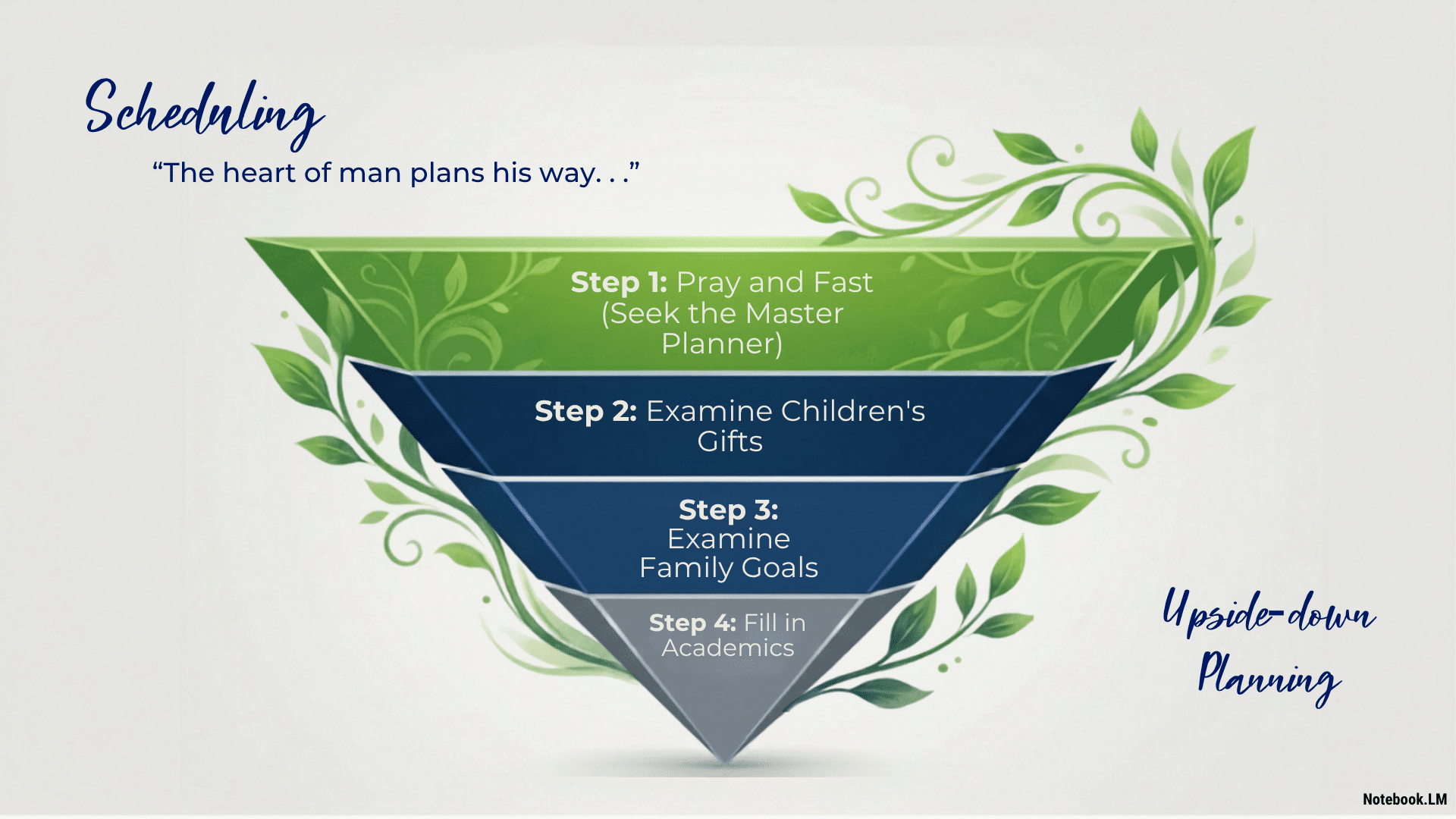
The heart of man plans his way (make a schedule), but the LORD establishes his steps (let God lead each day). Proverbs 16:9
The Lord gave me the perfect verse to use as an outline to explain what I now do in my homeschool. There are two parts: Our plans (schedule, daily to-dos, etc.), and God’s plans (how He orders each day specifically for its purpose). This is a mindset that acknowledges the Master in our master plans. We submit to his changes. We plan the schedule, but we let go of it and trust Him when He comes along and messes up our neatly organized day.
Life Schooling Guide to Scheduling
Let’s talk about the first part of that verse, the planning part. Now, there is a lot of freedom here, but to schedule according to a life schooling philosophy, I think it’s important to keep our purpose in mind. Remember the definition of lifeschooling:
Lifeschooling is the individualized process of discovering your child’s God-given gifts and talents primarily through real life experiences that happen within the context of your family’s unique situations and missions.
This is something I try to keep in mind when I create a schedule each year.
Now, when you schedule from a lifeschooling mindset, it’s kind of opposite of the way most people schedule. You’re not going to think first of what subjects you want to teach and then how you can go about teaching them….or what “holes” you need to fill in.
You’re going to think first about your children and your relationships. You’re going to think first about life and then about the subjects that your natural life-learning experiences provide. This style of homeschooling is relationally and missionally focused, so you start there and let the subjects flow from that.
Life Schooling Guide Step 1: PRAY.
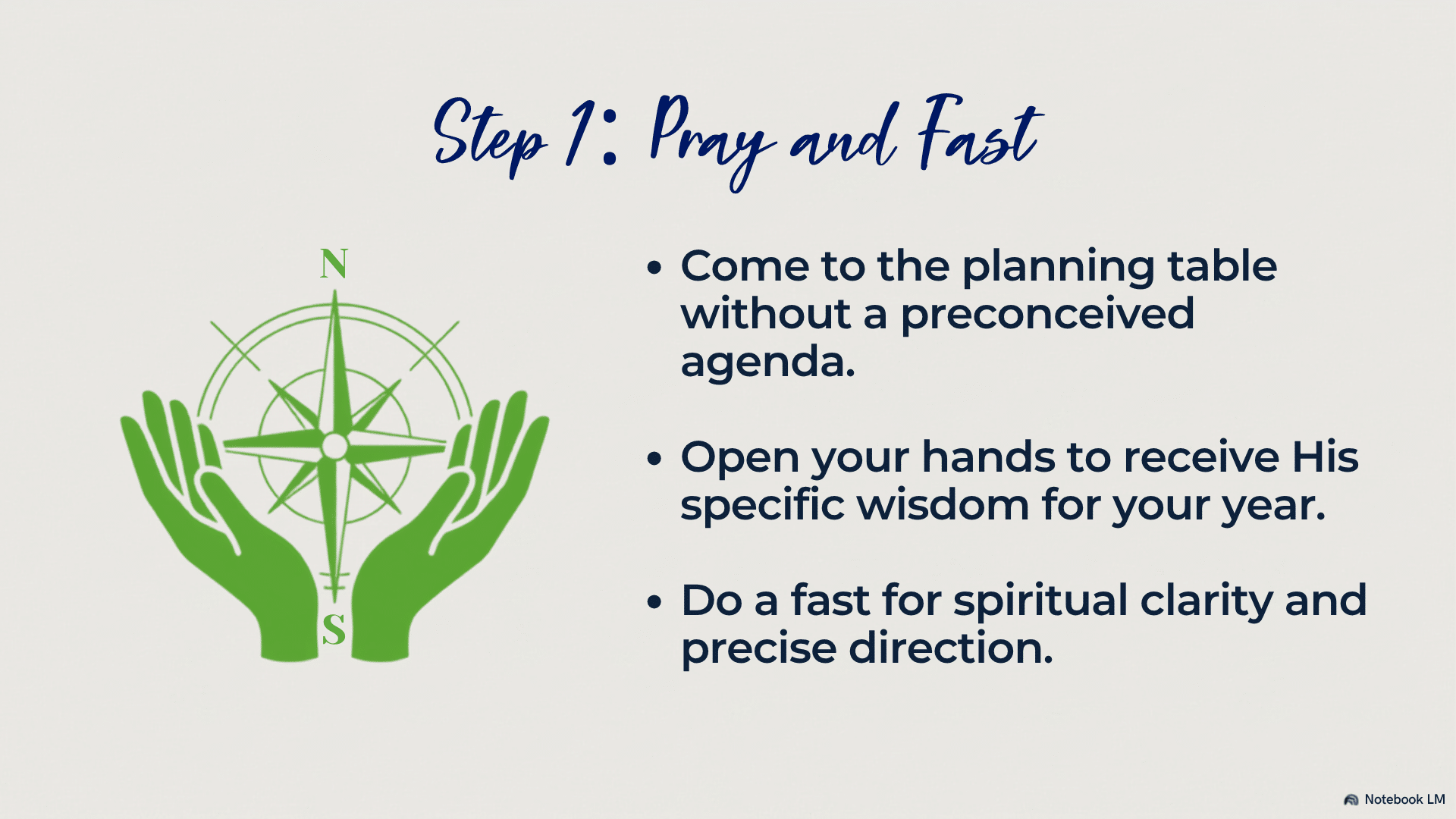
“Pray” may sound cliché and obvious, but we need to pray like we really mean it. Jenny and Sarah prayed…but notice they didn’t start there. It was step two, only after they had already decided what they wanted to do. Sometimes we look to God to approve our plans rather than direct them.
We need to come before God without any agenda or thought as to what we think things need to look like. We need to come with open hands to receive His wisdom on what our year should look like. After all, how can we receive His wisdom if we are holding onto something else? And when you pray this way, you may be surprised (as I have been) where He leads you!
I think it’s also very important to consider fasting as part of this process. Fasting can help you discern God’s will and we see examples of people seeking the Lord in this way all throughout Scripture. Even Matthew 6:16 is worded as an expectation (“When you fast,” not “If you fast”), but many of us have never done this with spiritual intent, even for one meal.
Life Schooling Guide Step 2: Examining my children’s gifts or leanings
God may have already shown you exactly what to do in step one! You may be able to breeze through steps 2-4. But this will help give you further direction.
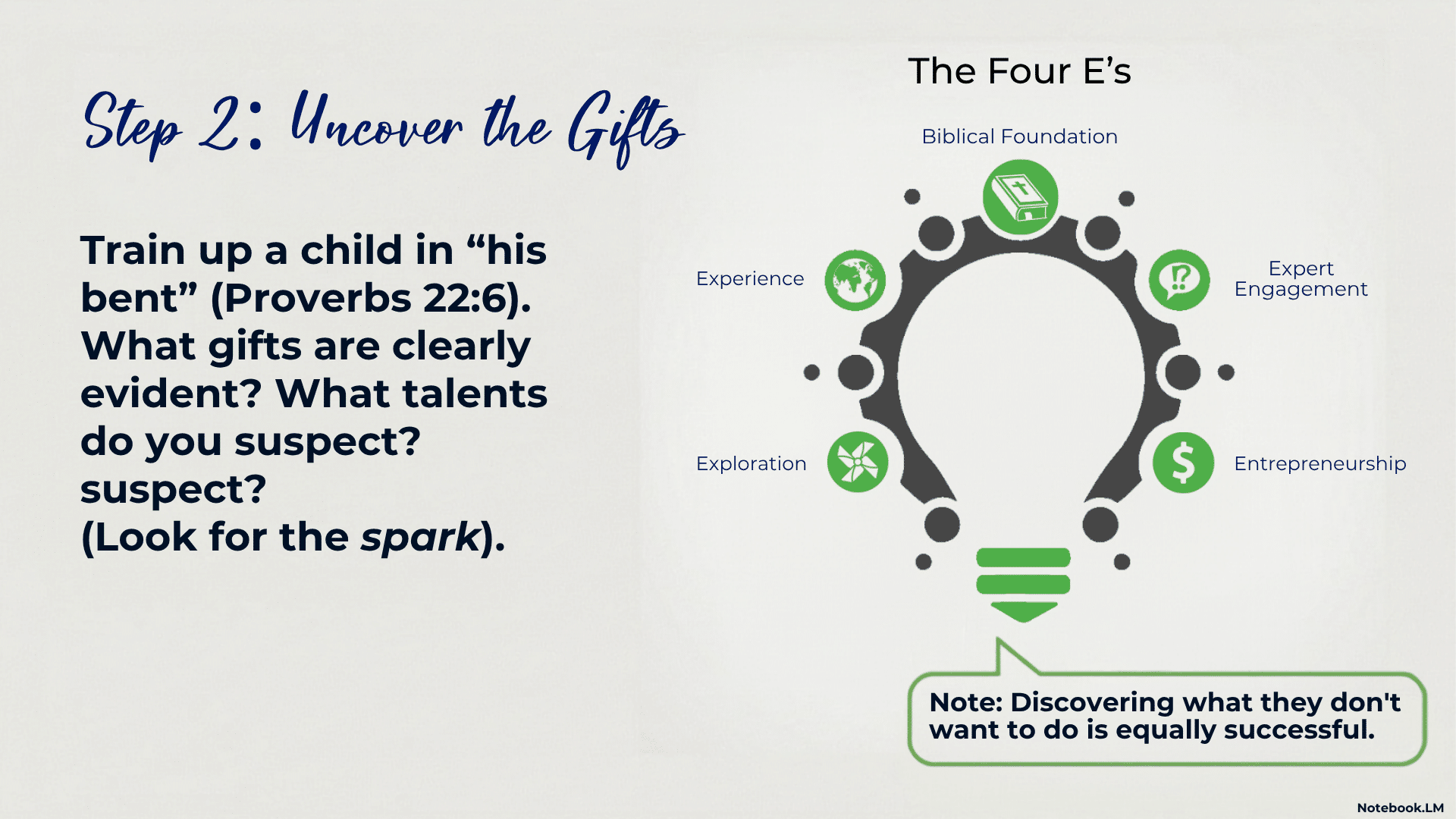
“Train up a child in the way he should go (his bent) and when he is old he will not depart from it.”
One popular misconception that many Christians have about this verse is that “the way he should go” is referring to spiritual things, but it’s actually better translated “according to his bent.” (I first heard this in a book called Gifted: Raising Children Intentionally, written by pioneer homeschooler and friend, Chris Davis. I dedicated my Lifeschooling book to him. His book is no longer in print, but if you can find a copy that’s affordable, grab it!)
God put specific gifts into our children so that they can accomplish a specific mission for Him on this earth! Those gifts are valuable and important, and our job as parents is literally to help train our children in their gifts, their “natural bent,” so that they might bring Him glory as they become experts in those gifts and serve others with them!
Some children make their gifts know practically right from the womb! For others, it can take time for us to see them appear. But often, observation is the missing key. We just need to be intentional about paying close attention to those things that make their eyes light up and their speech speed up!
Ask yourself these questions:
What gifts do they clearly have?
Again, you may not know this immediately, but keep observing! One day, I took a few minutes to intentionally watch my youngest child and see what I noticed. He was walking around the room, using a key to try to open things. He seemed to be trying to figure things out, and I thought, “He has a mechanical mindset.” He’s 14 now and still very mechanically-minded, and loves anything that leans that direction.
How are we currently developing their gifts and how can we continue to develop them (real-world experiences)?
In my book, Lifeschooling: Learning to Think Outside the Curriculum Box, I talk about the “Four E’s,” which is a sort of pathway for finding and developing your children’s gifts.
When they are young, we give them plenty of time for Exploration, through playing and reading. As they get older, we broaden the scope and give them Experiences learning through field trips, deeper topic study, and other resources.
As we see certain topics rising to the top and gifts emerging, we can then look for mentorship and apprenticeship opportunities in phase three, the Expert Engagement phase. And finally, they learn to use their gifts by serving others in the marketplace through the Entrepreneurship phase.
I believe all these phases are an important part of the process of finding and developing gifts, but of course, they don’t necessarily have to travel through them in a strictly linear route. Even as adults, we continue to “play” as we explore our world, and I’ve seen some amazing 6-year-old entrepreneurs, too! But I think this is a helpful way to think about it.
And all of these “E’s” rest on the foundation of a home that is biblically-focused and putting God first every day.
What gifts do I suspect are there?
“Knowledge which is acquired under compulsion has no hold on the mind. Therefore do not use compulsion, but let early education be a sort of amusement; you will then be better able to discover the child’s natural bent.” ― Plato
As I’ve mentioned, one of the best ways to discover our children’s gifts is to give them lots of time to play, especially when they are young! Also, don’t discount the role of genetics. Your kids have your genes, so chances are they may have similar gifts to you or your spouse. Look for those tendencies.
How can we explore those potential gifts?
Once you start to see some things emerging (or think you do), dig into various resources that are available, such as YouTube videos, courses (Udemy is a great place to check), field trips, etc.
If your children are still young, you may not yet see a lot of gifts, but you can start by exploring the interests you do see. You may also want to put a little more emphasis on the second step of examining family goals/ministries. In this way, you will start to discover more of your child’s gifts while also fulfilling your own calling.
Pursuing your own goals (within reason, as God leads) is nothing to feel guilty about! When I was a young mom, I tried to squelch my entrepreneurial bent, thinking it had no place in my life at that point. And of course, my time was naturally more limited with little ones. But gradually I realized that the Proverbs 31 woman was quite the entrepreneur! With young children! So maybe it was okay for me, too? Balance is always the key, of course.(Prov. 31 woman).
Think how many children follow in their parent’s footsteps, especially when we look at education historically. Going into the “family business” has been a common pathway for kids all throughout history. Even Jesus was a carpenter like his father, Joseph. Our own children have gone into similar fields and had overlapping interests as my husband and I. They do have our genes, right? I also think it’s important for children to recognize their parents as individuals with their own callings. Which brings us to the next point…
Life Schooling Guide Step 3: Examining our family ministries/goals
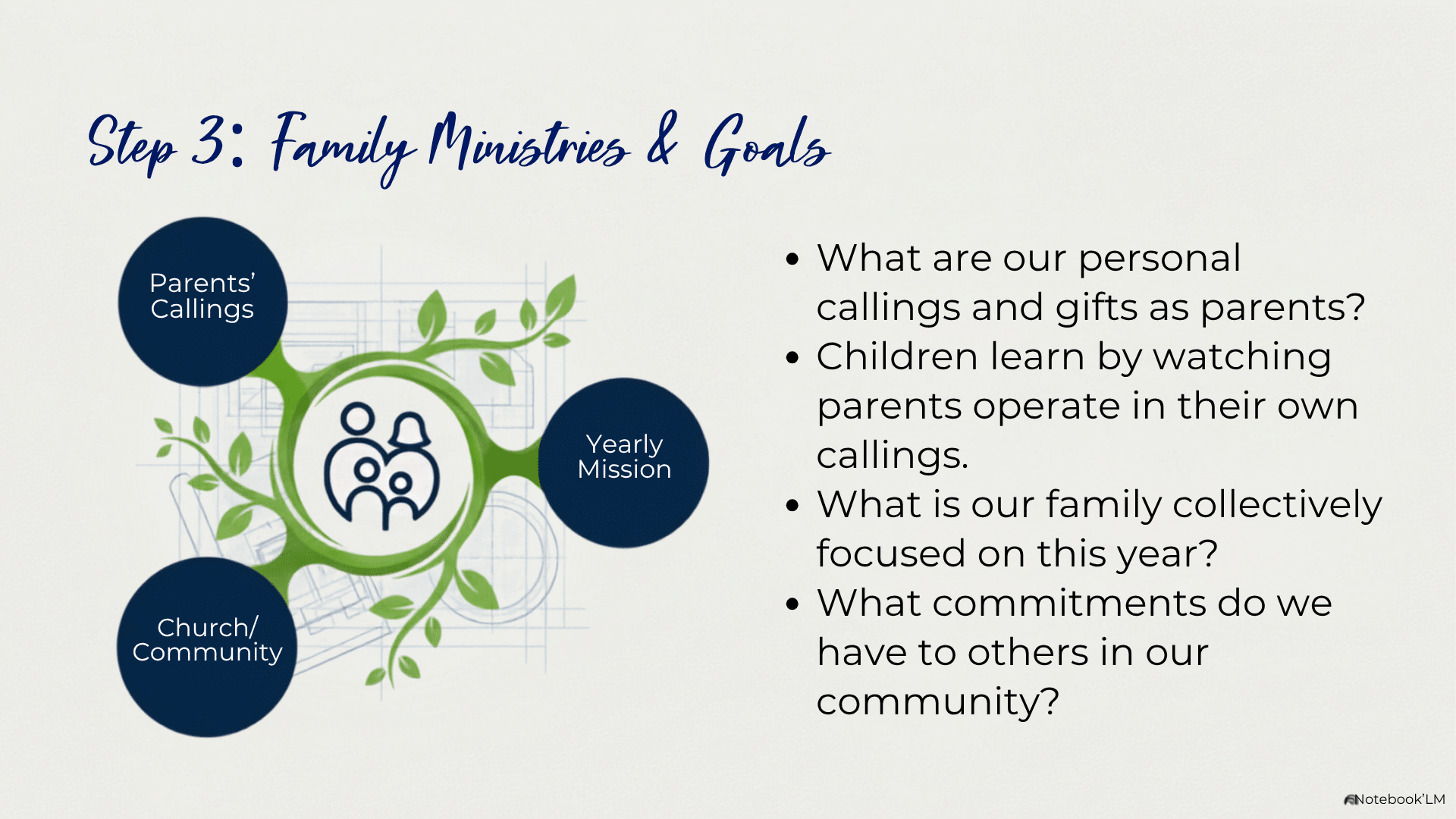
What are our personal gifts and callings as parents? What have we been focused on as a family the past year? What do we feel God leading us to accomplish as a family this year? (Is it the same as last year? Missions can change). What commitments do we have to others (church, extended family, neighbors, etc.)?
These are all important questions to ask in regard to family ministries and goals. When children serve alongside us, they recognize that they are not the center of the family. There is a mission that is bigger than the individual. But through this, we can give them opportunities to use their gifts and to discover ones that we didn’t even know were there.
Life Schooling Guide Step 4: Fill in with any academic knowledge you think God is leading you to teach at this point
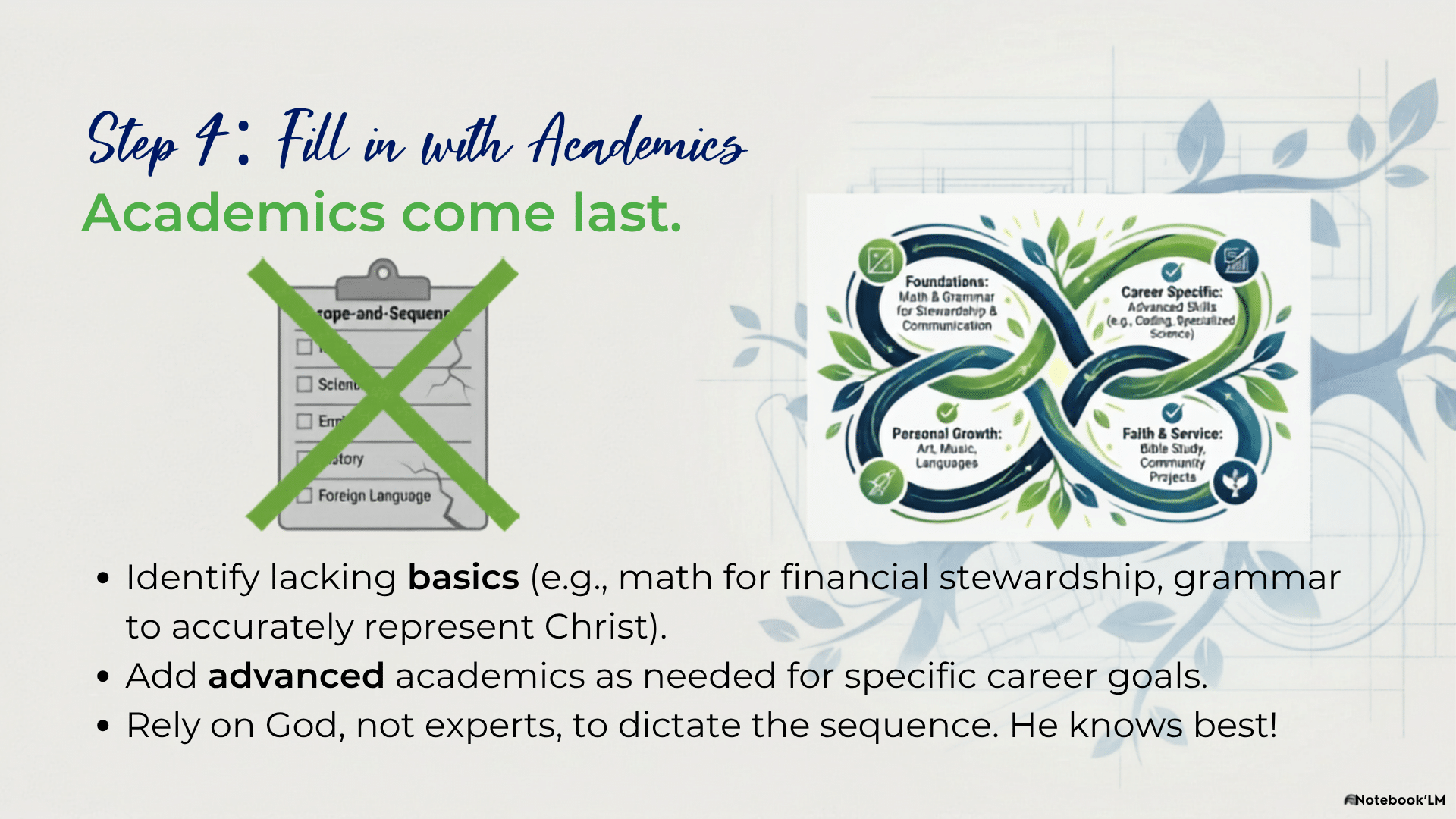
Now we get to step four, the one that most parents start with! We’ve flipped the schedule on it’s head.
What basics are lacking?
- Basic math knowledge is needed to balance check book, be good steward.
- Basic grammar/communication skills to represent Christ well and tell others about Him.)
What advanced academics does this child need to accomplish his/her goals?
- Things beyond basics. Advanced math to become engineer.
- Knowledge of diagramming sentences to become writer.
Note we are ending with the academics in step four. It may seem backwards to end with the academics, but biblically-speaking, isn’t this the right order? Perhaps you also noticed that I have not mentioned anything about scope and sequence or what they “should” need to know by their particular age. That is because I don’t believe the “experts” (those who create the scope and sequence and decide what my five-year-old needs to know) know more than I do (about my kids) and they certainly don’t know more than God.
I let Him direct me in what my children need to know. He directs through their interests and through the life experiences and other opportunities He brings into their paths. He promises that the end will work out if I trust in Him and seek His wisdom first.
Again, this thinking is backwards from the world’s thinking. We should start with seeking wisdom and focusing on God and our family relationships, and the rest follows. Academics should be last. This entire process is bathed in prayer and supported by faith. Start by asking. Then trust when He directs you opposite of what you think…because that’s what often happens!
In creating your schedule, I want to give this tip that has worked for us over the years: Cut out as many extracurricular activities as possible, especially when your children are younger. Why? Here are a few reasons:
-
First of all, this will free up your time and give you more time with your family. Many people say they homeschool to be with their family more, but then they sign up for a bunch of extracurricular classes and run all around the city all week long. I don’t see a whole lot of difference between families with kids in traditional schooling and families who homeschool. In fact, sometimes homeschoolers are even busier! At least with school you only drop off and pick up twice in a day. If you homeschool and sign your children up for many activities, you can run around all day, every day, dropping off and picking up children! (That being said, there are seasons, especially when your children get older, where you will need to run around more. Use this time for relationship building conversations or for “carschooling.”)
-
Secondly, it will also give you more opportunities to say “yes” to unexpected things that God brings along. We can’t always know what ministry opportunities He may have for us or our children. If we pack our schedules too tight, then there is no room to say yes to these things.
-
Thirdly, especially when children are younger, there is a certain amount of risk in putting them in a classroom situation. The same bad influences and peer pressure can exist (though maybe on a different level) in a homeschool co-op or class as in public schools. It is crucial for your children to have a strong sense of who they are in Christ before putting them into an environment where they feel the need to fit in or compromise to any degree. They need to learn those skills, but it may be a few years before they are really ready…not necessarily when they are elementary school age.
-
Finally, if you want to learn to think differently, it’s not usually good to be around people on a regular basis who think opposite of the way you do. Of course, it’s good to be sharpened and to see the other side of things, but most of us have been so ingrained to think about education in a school mentality, separating all the subjects and compartmentalizing learning, that we don’t need to be surrounded by others with that mentality who will only make it harder for us to break out of it.
-
- Do you really need to be constantly hearing about all the ways your friends are preparing their children for college if your children are on an entrepreneurial track?
-
- Do you need to hear a run-down of the different curricula they are using for all the different subjects if you don’t believe in breaking things down like that? Probably not. If you are like most people, you probably need an “incubation time” in your home to really solidify your beliefs about education and come to a lifeschooling mindset through practical application of your ideas and seeing them succeed.
Look for ways that learning can happen within the home. That may even mean that not every child gets to participate in an outside activity. If it means extra family time, they probably won’t mind! There are many tempting activities, especially if you live in a big city with a large homeschooling population. And I’m not saying to necessarily cut everything out.
What I am saying is to focus on the gifts in your children that seem to “float to the top,” and if it is an area that you don’t see a natural overlap with your family life or you can’t imagine that you could teach that subject or find a resource for them to study individually, then definitely find an outside opportunity. The bottom line: Be selective. Make sure the time investment is worth the time taken away from your family life and the potential influence of people who think with a different mindset.
No matter how your particular schedule turns out, there is one non-negotiable time that needs to be on there. Make Family Worship time your cornerstone “non-negotiable” school time. Why? Because this is one of the best ways to practice Deuteronomy 6:4-9! Your children need to learn early how to properly prioritize their lives. They need to learn that the their relationship with God takes precedence and that being together as a family is also very important. They need to see the father as the spiritual leader in the home.
By doing daily family worship, you are emphasizing these things on a regular basis. AND, you will be very surprised by the academic learning that takes place, as well! This goes back to the lifeschooling theme verse. The spiritual pursuits should come first, and when put things in the proper place, God will bless it.
One night, we were having family worship and I started to make a mental list of all the academic skills we were doing at the same time, without even realizing it. We were going through the Catechism, so of course, there is the obvious character development and Biblical literacy. At our church at the time, we would go through the catechism with the children every week, so they began to memorize the answers, also. Our youngest son, who was five, read each answer. Some of the words were huge, too, and he was able to read it!
We also sang together as a family, so there was music class. With the music, we would download YouTube videos of songs and play them on our TV. Often, there were issues with grammar or punctuation, so we would point that out. We were reading a book on end times, which gave our youngest one a chance to stretch his mind and build more advanced speech/communication skills. We also read a Bible story that was more on his level, stopping at the end of paragraphs to ask questions to see if he was listening. I noticed, also, that we were studying the 10 commandments in our catechism…a chance to learn numbers and counting.
It took us about an hour or an hour and a half to have this time together as a family. Perhaps you think you can’t devote that kind of time to family worship, but…you’re wrong. Cut some of the other things out of your life! This is an hour and a half of time building the most important relationships you have in your life. You can afford to cut out some academics or extracurricular activities for this. Relationships are eternally valuable. And as we’ve show, God will multiply your efforts and cause “all these things” to be added to you! The academics are built in.
Submitting to Divine Detours
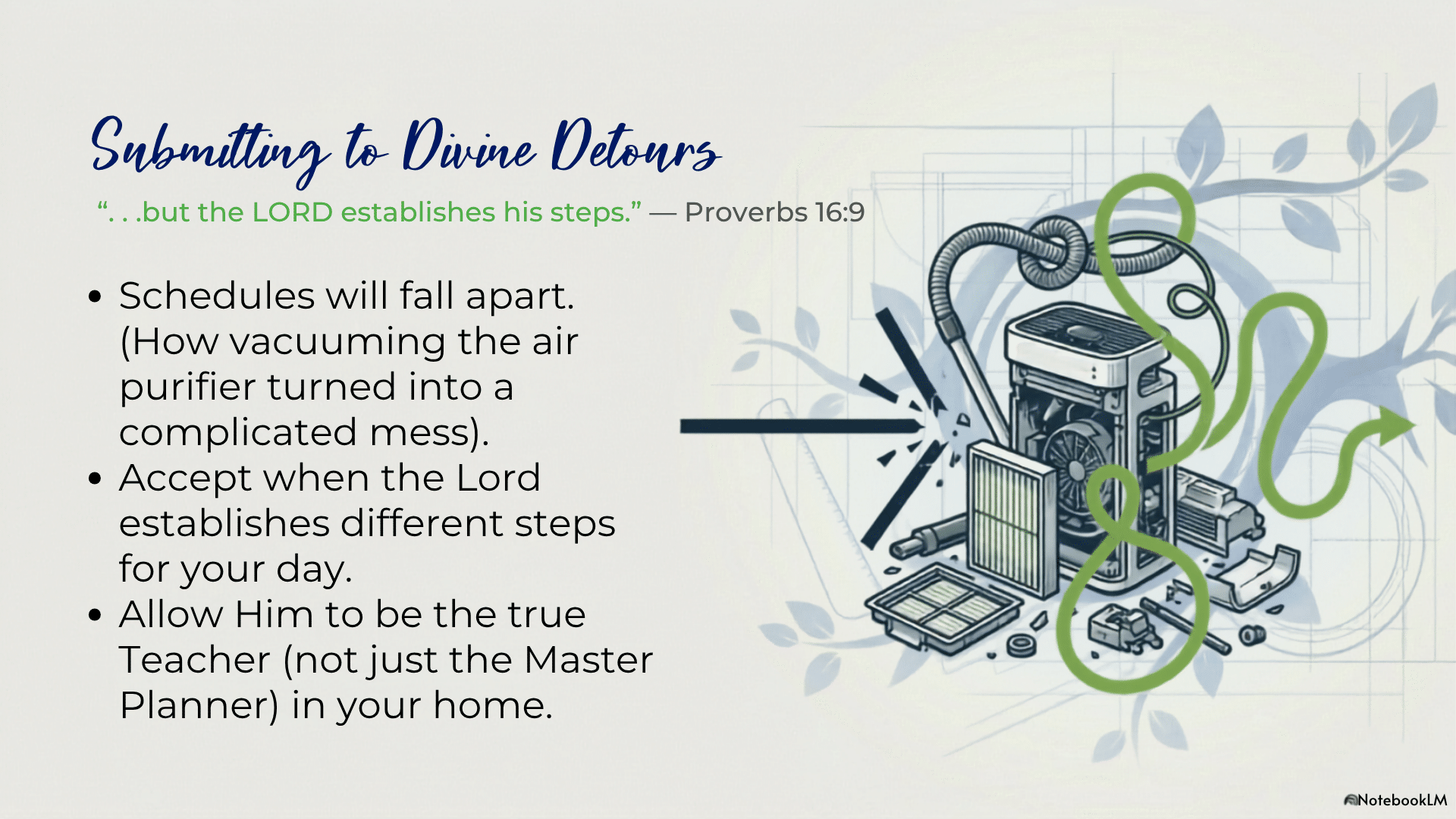
Now that we’ve created this schedule, let’s talk about the second part of that verse. “…but the LORD establishes his steps (let God lead each day).”
So, you’ve got this great schedule, but do not…let me repeat, DO NOT…expect your schedule to go according to plan. It won’t. In fact, I would challenge any honest homeschooing parent to show me one day when the schedule goes exactly according to plan. I mean, does anything in life go according to plan? Think about just the daily to-dos on your list. How often does something simple on your list turn into a complicated job the minute you try to just get it done and crossed off.
Here’s a random question for illustration purposes: How long do you think it takes to vacuum an air purifier?
One Christmas was particularly busy for us, and for about a week, I had been trying to vacuum our air purifier. Simple job, right? But it was on top of a tall bookcase in our room and dragging the vacuum in there did not sound fun to me. Finally, we were organizing one Saturday and I felt like I could get to it and knock it off the list.
Five minutes. That’s all it should have taken and about all the time I had.
Rather than tell you the entire drawn-out version of the story, let me just say what it ended up involving:
- Finding a chair to stand on (it was on top of a tall bookcase)
- Moving a heavy box off of the vacuum cord (my vacuum had been sitting there waiting for me a while to get this job done)
- Finding a screwdriver when I realized I should also replace the bulb in the unit at the same time
- Using an electric screwdriver when I couldn’t find one
- Whir, whir, whir…a stripped screw
- Finding pliers to yank the back panel off
- Resorting to a screwdriver instead
- Yanking the panel off and breaking the lightbulb inside
- Stuck broken lightbulb
- Finding leather gloves to remove the lightbulb
- Discovering the strangely soft and crunchy item in the finger of the glove was a smashed snail
- Removing broken bulb, replacing with new bulb
- Returning air purifier to top of bookcase and turning it on.
- Click, click, click.
- Discovering I had unplugged it months ago in anticipation of cleaning it.
- Pull out heavy bookcase to plug air unit in.
- Plug it in, discover the bookcase won’t go back against the wall.
- Remember the surge protector under the bookcase is where I should plug it in.
- And finally….SUCCESS!!
So, how long did this five-minute job of dusting an air purifier take? Over an hour if you count the time it took to write out this illustration and put it into this Life Schooling Guide for you. So, these five-minute jobs rarely end up being only five minutes. A schedule and expectations have to be realistic and unfortunately, reality is that your schedule will rarely function exactly the way you’ve planned.
Schedules and children rarely cooperate. But, God has a plan. My five-minute job was for Him an opportunity to teach me patience and to end up with a good illustration for this Life Schooling Guide. I may not have gotten to other things in my schedule, but not only did I get it dusted, but I also replaced the lightbulb and put this section in my post.
The problem isn’t that our schedules don’t go according to plan. The problem is that we don’t accept when they don’t go according to plan. We don’t accept when the Lord “establishes our steps” differently than what we had planned. So, the schedule is a guide. But when it doesn’t go according to plan, we need to try to see what God is teaching. Sometimes we don’t really allow Him to be the teacher in our homes. We have the master plan and we ignore the Master’s Plan. Never forget that no matter how good your schedule looks on paper, His unique plan for each day is always better.
What does this all look like in real life?
In our family, we signed up for very few outside activities over the years. In fact, many years we had no other outside classes and it worked very well for us and gave us a lot of flexibility. But my daughter, Elleina, has a wonderful gift of acting. Through the years, she acted in plays at our small church. It gave her a chance to get comfortable acting in front of a smaller group of people she knew and she grew to really love it.
This fit in beautifully with our family life and what we were already doing. But as she got older, she wanted to do more with it. So we signed her up for a Christian homeschool theater and she actually landed the lead role in the play! She later went on to act in several Christian movies, some of which were theater releases, so it was exciting to see how God used the tiny beginnings in a big way.
This was a big time commitment (every Thursday, with daily classes closer to the play) and we really prayed about it before making the decision. I was very hesitant about it because it seemed like it was going to really be a disruption to family life. But I love how the Lord clearly led us to do this activity because we can now look back and see how it fit so perfectly into our lives and God was truly directing our paths.
First, it made Thursdays a day that she and I got to actually spend more time together. Like most girls, she needed more one-on-one time as she went through those early teen years, so Thursdays gave us a 30-minute car ride alone together both ways to talk. Secondly, it also benefited my oldest son, as he was in charge of dinner those nights and we counted that as a “Home Ec” credit.
And, while I thought the time commitment was going to make my Thursdays more difficult, it was actually a blessing in disguise. Her two-hour class gave me time to work on some things alone in another room, then run get groceries at a store nearby that I already had in my schedule each week anyway.
We planned our way and the Lord directed our steps, integrating life with homeschooling in such a beautiful way!
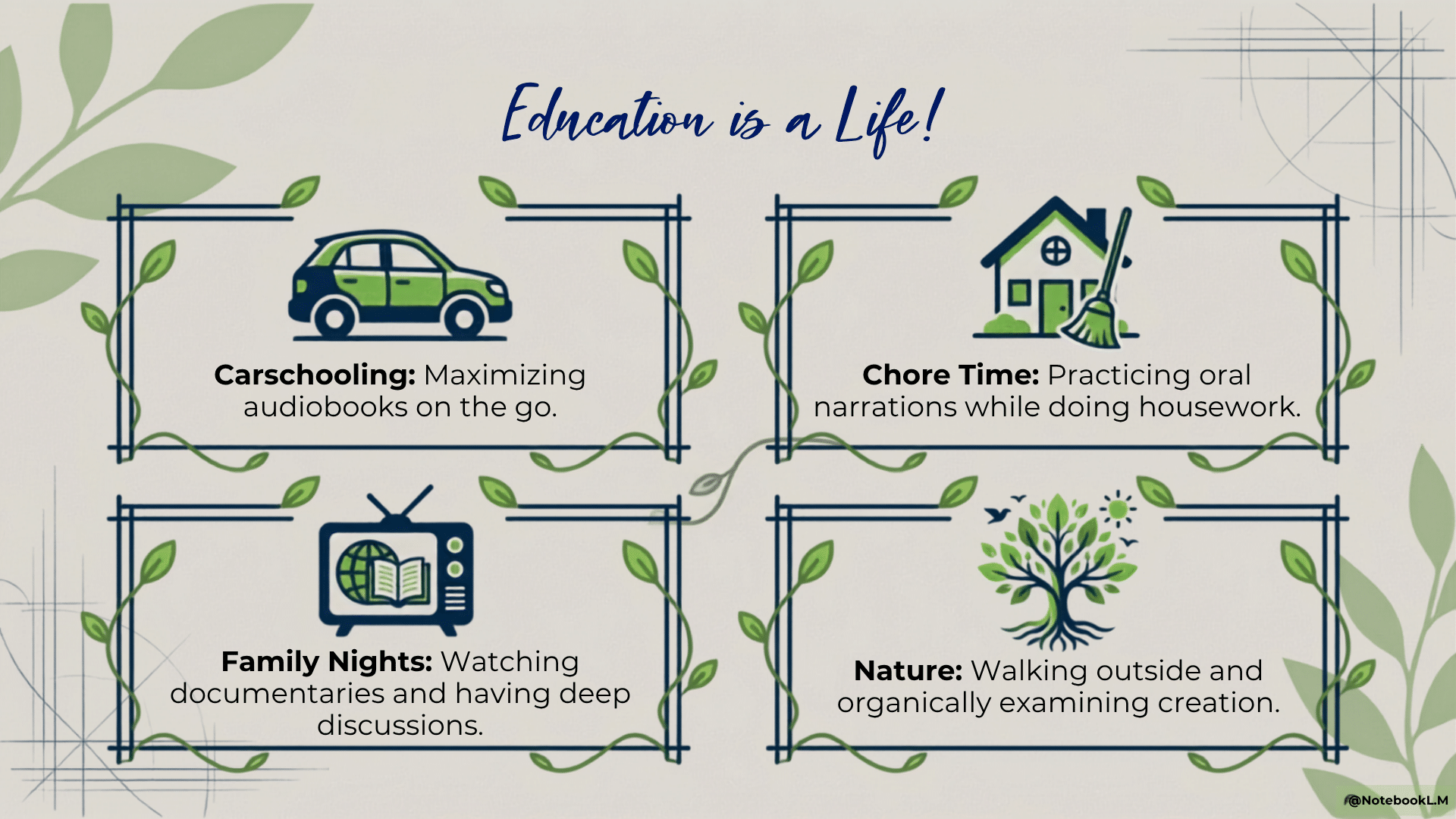
As you can see, education does not need to take place at a desk, or even at your kitchen table! And it can happen very naturally. Here are some easy ways to fit education into your everyday life:
- “Carschooling”
- Listening to audiobooks while working on dinner, doing dishes, or folding laundry
- Talking together (narration) while doing housework
- Watching a documentary or educational movie for family movie night
- Examining God’s creation while playing or walking outside (exercising, caring for God’s temple)
- Counting while cleaning up toys, etc. (“We have six toys to put away and I will put away two. How many will you put away?”)
Look for ways to turn any activity or event into an educational experience and you will find them! You don’t have to plan a lot, either. Even the little lessons are meaningful…they don’t have to be life-changing or heavily academic. Just be open-minded to what God brings into your path and look for the hidden education that’s already there. Again, a lot of times it’s just backwards thinking…live life and then observe how the academics have happened naturally.
Life Schooling Guide: Conclusion
God has made us unique individuals and we will each struggle with this verse differently. Some of us organizationally-challenged types (hand raised) may find it very hard to come up with a schedule and stick with it. We find “planning our ways” and creating a schedule hard. Relatable?
Others will find it hard to listen to the Lord daily and deviate from their schedules if that is what He directs. We find allowing the Lord to “direct our steps” much harder. God will meet each of us where we are and lead us to where we need to be.
So, if you feel discouraged, let me leave you with a little bit of encouragement as we come to the end of this Life Schooling Guide. You know that $400 curriculum that I “wasted” money on because I didn’t do things the “right way”? Even through our mistakes, God still works. He is still “directing our paths.” Even though we only spent about 3 weeks using that curriculum, it turns out that it was not wasted after all. One book that was recommended turned out to be one of my children’s favorite books. In fact, it was the book that finally got my daughter interested in reading and became an inspiration for her novel and many of her other writing projects.
So, truly, no matter how you homeschool, if you do your best to plan your ways, God will direct your steps. I pray this Life Schooling Guide will help you in that process!
Back to Homeschool Giveaway!

You may not believe it because of the current weather, but fall will be here before we know it! And with it, a brand-spanking new homeschool year and lots of curriculum costs! They add up, don’t they? (Especially if you pay $400 for a curriculum you use for three weeks…ahem…see above blog post.)
To help ease your pocketbook pains, a group of my fellow homeschool bloggers and I have come together once again for our 13th Annual Back to Homeschool Giveaway!
Yep, you may be one of three homeschool families to win a $200 gift card to the homeschool curriculum company of your choice! Whether your family uses Master Books, Gather Round, Notgrass, My Father’s World, Rainbow Resource, or another favorite publisher, you get to decide where to use your prize.
The giveaway runs July 15 through July 24, so enter now before you forget.
Simply complete the entries in the SweepWidget form below. Every participating blogger has helped make this giveaway possible, and each completed entry gives you another opportunity to win.
We hope this giveaway is a blessing to your family and helps make your homeschool year a little more affordable.
Giveaway ends July 24, 2026, at 11:59 PM ET. Three winners will each receive a $200 gift card to the homeschool curriculum company of their choice. Winners will be selected and notified by email shortly after the giveaway ends and will have 48 hours to claim their prize.
By entering this giveaway, you agree to be added to the email lists of the participating homeschool bloggers. Please review the official Terms & Conditions before entering.
Having trouble entering?
If your entry is flagged as spam or SweepWidget won’t allow you to continue, please review the troubleshooting guide here:
https://sweepwidget.com/docs/contestant-faq
If you’re still unable to enter, please email Sarah at sarah@myjoyfilledlife.com with the email address you’re trying to use for the giveaway. She’ll add your email to the safe list so you can proceed with your entry.
We apologize for any inconvenience. These safeguards help prevent fraudulent entries and keep the giveaway fair for everyone.

- Life Schooling Guide: Steps to Planning a Relaxed Homeschool - July 15, 2026
- Top 10 Websites for Game Education Online - May 25, 2026
- Paper Making How to Guide - May 15, 2026









2 Comments
I really appreciate this perspective! Focusing on a child’s unique gifts and learning through everyday life feels so much less stressful than trying to follow a rigid checklist. Thanks for sharing such an encouraging reminder that education doesn’t have to look the same for every family.
I’m so glad you found it encouraging! 🙂 It is amazing to see how much our children can learn when we give them freedom to pursue their gifts!