How to Write a Christian Homeschool Mission Statement
Do you have a homeschool mission statement? If you’re squirrel-brained like me, you’ve never actually sat down and written out a mission statement, but you probably have a pretty solid idea, floating around somewhere in the back of your head, of your end goals in homeschooling.
Well, my squirrel-brained compatriot, I think it’s time we got this down on paper, don’t you? Actually, now that I think about it, I have written out a mission statement…only I don’t actually call it that.
NOTE: Don’t miss out on the 🌧️☔ 2026 April Showers Spring Giveaway! Link at the bottom of this post for your chance to win a $125 gift card!
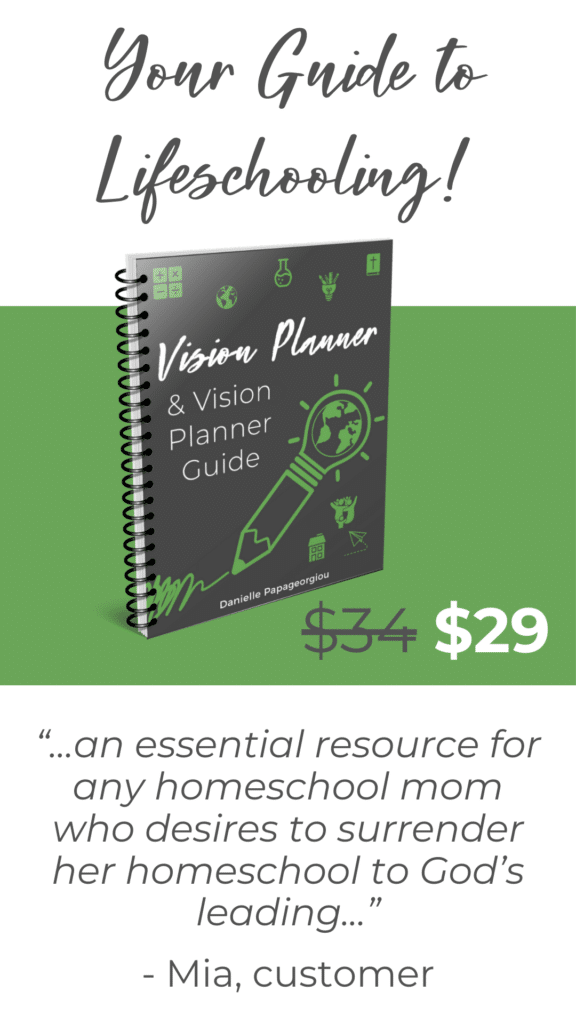
One of the exercises I include in my Lifeschooling Vision Planner is called “Vision Sessions”…two simple pages where we plan out a Long-Term Vision for homeschooing, as well as a Short-Term Vision for the upcoming year and what we want to accomplish.
I tend to think of a mission statement as more of a formal statement, written in paragraph form. But my Long-Term Vision is basically the same information in a more succinct style. Parents write down all the things they want to accomplish in lifeschooling their child by the time they graduate from high school.
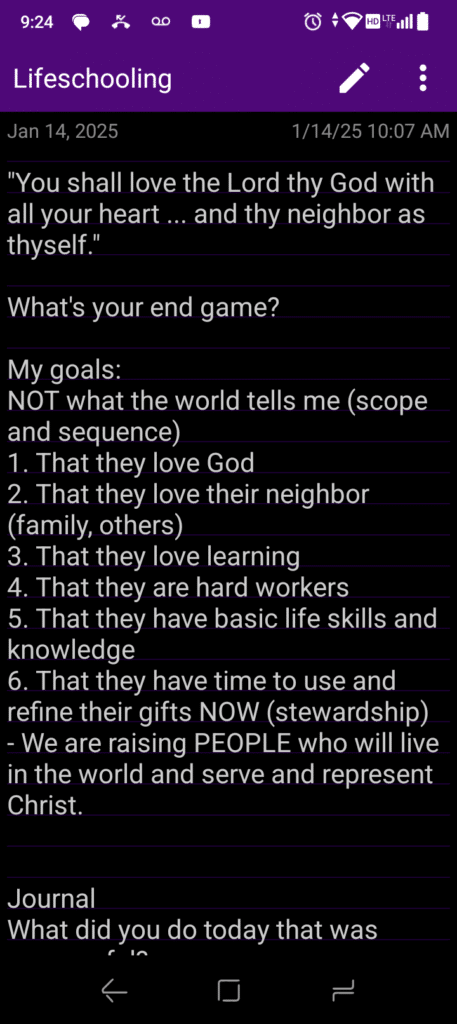
So not only did I fill out the Long-Term Vision in my planner, but in fact (and if you know me at all, you won’t be surprised by this), I actually found an entire separate list buried in a notes app on my phone!
But I guess it doesn’t hurt to write these things out more than once. 😜
Here is the list I found in my phone (with a few embellishments), which I happen to like better:
My goals:
NOT what the world tells me (scope and sequence)
- That they love God.
- That they love their neighbor (family, others).
- That they love learning.
- That they are hard workers who “redeem the time.”
- That they have basic life skills and knowledge.
- That they have time to use and refine their gifts NOW (stewardship).
We are raising PEOPLE who will live in the world and serve and represent Christ.
I really like that last line because I think the system often treats children like they are cogs on an assembly line…which, if you know the history of public education, is not surprising, as that was kind of the point.
We want to avoid dehumanizing educational practices that treat every child the same instead of uniquely gifted “masterpieces” created by the Master Designer! We want to ask ourselves “Who Is This Child?” (Hey, I have a journal by that name!) and figure out what God put in them to do.
So, now that we have some context and an example, let’s jump into some practical thoughts on homeschool mission statements. Whether you decide to purchase the Lifeschooling Vision Planner and go through the questions in there, or simply write your homeschool mission statement on your own, these are some thoughts and practical tips.
Understanding the Importance of a Homeschool Mission Statement
Okay, let’s back up a minute and talk about why a homeschool mission statement is actually important. I guess we should have started there, but… squirrel-brain.
There are soooo many homeschooling resources, co-ops, and activities out there and for those of us who have Shiny Object Syndrome, it can be way too tempting to buy everything that looks cool or has great reviews from other homeschool parents.
A homeschool mission statement is like a filter that you can run each idea through. It makes it much simpler to evaluate a resource when you know what your long-term vision is!
Plus, if your whole family has an understanding of this vision, it makes it much easier for them to also get on board with the short-term vision and recognize what opportunities just don’t fit well.
Key Elements of an Effective Mission Statement
Goals and core values are two key elements of a solid homeschool mission statement, and they kind of go hand-in-hand. Your values (love for God, love for others, curiosity, independence, hard work) will direct your big-picture goals.
In my planner, I lay out some questions in three separate forms: One for you, one for your child, and one for your whole family. Getting granular helps with the big picture, but here are a few high-level questions to ponder:
- What are some things that are important to you and your family?
- Why are you homeschooling (lifeschooling) to begin with?
- What practices do you hope to avoid?
- What’s your end game?
Think of your mission statement in terms of “3 C’s”: Concise, clear, and compelling. You want the overall concept to be easy to internalize so you don’t have to carry a five-page document around. It’s a mission statement, not the Declaration of Independence.
How to Reflect Your Educational Philosophy
Think about your own homeschooling educational philosophy. Maybe it’s not exactly like Lifeschooling, or maybe it’s a bit of a hybrid of several philosophies.
Do you believe in a child-centered approach, where learning is guided by the child’s interests and pace? Do you align with a Charlotte Mason approach, with a strong focus on art and music, and narration? Or do you prefer a more structured, classical education model?
Reflecting your educational philosophy in your homeschool mission statement keeps you from buying that $500 classical homeschool curriculum because it was on sale for $300, and you think you can adapt it to fit your relaxed lifeschooling, interest-led family.
No. Just no.
If you are a lifeschooler, focused on experiential learning and hands-on exeriences, then having that written down in your mission statement will help you in the homeschool conference vendor hall to ruthlessly cull what doesn’t fit.
Breeders do it to get the best genes in their stock. Lots of cute little calves die because they’re not good enough. (Sorry, PETA, it’s true.)
Harsh reality! 😆 But listen, your husband will thank you (and me, for telling you like it is) when you don’t buy out half the vendor hall! If you can keep your philosophy clearly in your mind, it will hone your focus and your final “product” will be amazing!
Involving Your Family in the Mission Statement Process
Involving your family in the creation of your homeschool mission statement is kind of a biggie. News flash: Your children are not you! Even though they may change from week to week, they have their own hopes, dreams, and aspirations, and it’s important that they feel valued as individuals.
Remember, God Himself placed those gifts and desires in your children, and He didn’t do that without purpose! It’s important to figure out how their talents fit together and how they inform the big-picture mission statement of your homeschool.
This is where my planner helps to bring everyone’s vision together as you fill out what is important to each of you. After you work through the questions, you may have several family meetings to discuss what aspects should take top priority as part of the big vision.

During these discussions, ask questions that prompt deeper reflection. What are your family’s core values? What are the most important skills and knowledge you want your children to acquire (and what do they want)? How do you envision your daily homeschooling routine?
By exploring these questions together, you will refine the vision and come up with something that has a little piece of each of you. And when your children are involved, they are far more likely to take ownership and internalize the mission statement if it’s something they believe in!
Examples of Inspiring Homeschool Mission Statements
I wanted to include a few examples of more “proper” homeschool mission statements. Yeah, I like my sloppy phone list just fine. But for you Type A’s, who like to do things by the book, here are some good examples of homeschool mission statements that may inspire you:
“Our mission is to cultivate a love for learning through a child-centered approach, nurturing curiosity, creativity, and critical thinking, with an emphasis on a Christian worldview. We strive to provide a supportive and enriching environment that fosters academic excellence, character development, and lifelong learning.”
“Our homeschool mission is to create a Christ-centered learning community where our children can grow spiritually, academically, and socially. We aim to instill strong moral values, a love for God, and a passion for serving others. Through personalized instruction and experiential learning, we seek to develop well-rounded, compassionate individuals who are prepared to make a positive impact in the world.”
“Our mission is to provide a rigorous and challenging education that prepares our children for higher education and beyond. We value academic excellence, intellectual curiosity, and a strong work ethic, through a Christian worldview lens. Through a classical education model, we aim to develop critical thinkers and lifelong learners who are equipped with the knowledge and skills to succeed in an ever-changing world.”
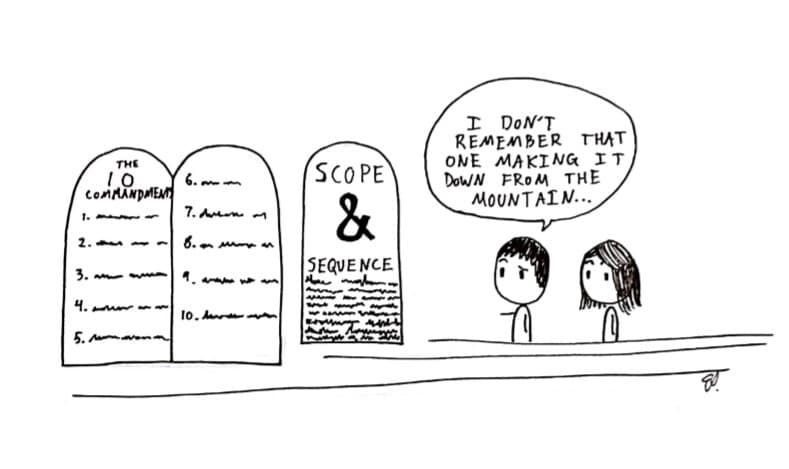
Remember, just like the school system’s scope and sequence, this homeschool mission statement isn’t written on stone tablets! You can (and should) be flexible enough to change it, when necessary. Let life (and the Holy Spirit, of course) be your guide.
Take some time each year when you do your yearly planning (or go over the Short-Term Vision) to look over your mission statement or Long-Term Vision plan and see if it still makes sense.
Circumstances and needs change over time, so why shouldn’t your mission statement? Check in with your kids, too. Their interests and goals change, as well, and their input is valuable.
Final Thoughts on Writing a Homeschool Mission Statement
A strong homeschool mission statement is a powerful tool in your homeschooling or lifeschooling journey that will keep you on the right track. It doesn’t have to be elaborate or complex. Keep it simple and focused, and you will be more likely to stick with the vision.
As for my own Long-Term Vision, I suppose if I were to sum it all up in one simple mission statement, it would probably simply be my Lifeschooling tag line (adjusted to be personal): We will strive to see the educational value in everyday life and focus on developing our children’s God-given gifts, so we can raise world-changers for Jesus!
Makes sense, don’t you think? That tag line came from my deep, personal conviction that education should be more than a generic scope and sequence handed to me from some “expert” trained in a public education mindset. So I’m sharing and encouraging you from my own vision!
And I just have to let you know that, by God’s grace, we have fulfilled this mission statement in 2/3 children so far (with the last one on his way to completing his education in a few short years)! I can go down through that list and answer “yes” to all the goals!
So maybe there is something to this homeschool mission statement idea?
I hope this helps you start to form some concrete ideas about your own mission statement…or finally just get all those ideas out of your head and onto paper!

The 2026 April Showers Homeschool Giveaway is hosted by Hope In The Chaos and will run from Monday, April 6, 2026, through Wednesday, April 15, 2026, at 11:59 pm EST. Entrants must be 18 years old or older and be a member of a current homeschooling family. Participating bloggers and members of their households are not eligible to win.
By entering this giveaway, you agree to be added to the email lists of the participating blogs represented here. The winners will be drawn randomly via Rafflecopter and notified by email no later than April 18, 2026. They will have 48 hours to claim their prize. Unclaimed prizes will be forfeited. Hope In The Chaos reserves the right to draw new winners if a winner is found ineligible or if the winner forfeits their prize. Prizes are non-transferable. Void where prohibited.

- Life Schooling Guide: Steps to Planning a Relaxed Homeschool - July 15, 2026
- Top 10 Websites for Game Education Online - May 25, 2026
- Paper Making How to Guide - May 15, 2026